

.svg)
.svg)


In a landmark decision handed down on 31 March 2026, the Fair Work Commission ruled that junior pay rates for workers aged 18 to 20 will be phased out across three major Modern Awards. For hundreds of thousands of Australian workers, and the businesses that employ them, this is one of the most significant wage change in years.
If you employ staff under the General Retail Industry Award, the Fast Food Industry Award, or the Pharmacy Industry Award, here's what the decision means, what the transition looks like, and how to make sure your payroll stays compliant through every stage.
What are junior pay rates?
.png)
Junior pay rates are discounted wage rates that have historically applied to employees under the age of 21 across certain Modern Awards. The rationale was that younger workers bring less experience to a role, and lower starting wages create an incentive for employers to take them on.
Under the current system, workers aged 18 to 20 earn a percentage of the full adult award rate, generally 70% for 18-year-olds, 80% for 19-year olds, and 90% for 20-year olds. Workers under 18 are covered by separate junior rates, which are not affected by this ruling.
What the Fair Work Commission has decided
The Fair Work Commission's full bench ruling affects industries such as retail, fast food, and pharmacy, and is expected to deliver pay rises to around 500,000 young Australians.
The core of the decision is straightforward: if they have six months of experience, all those over the age of 18 will need to be paid at the full adult rate. Workers with less than six months of experience with their current employer can still be paid the relevant junior rate during that period.
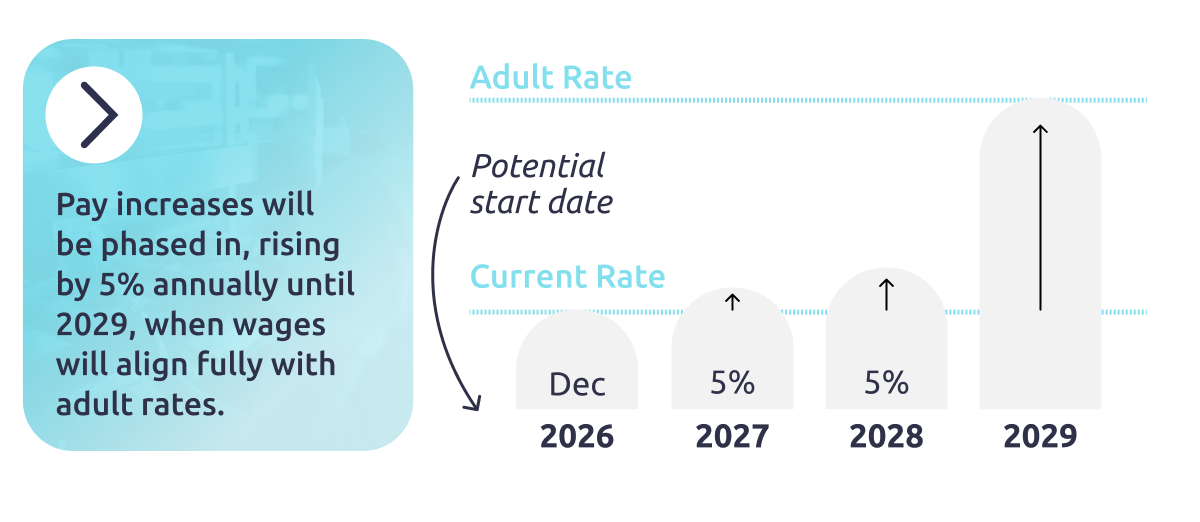
The Commission has indicated that these changes will be introduced gradually, with the changes potentially starting from 1 December 2026. Pay increases will be phased in, rising by 5% annually until 2029, when wages will align fully with adult rates.
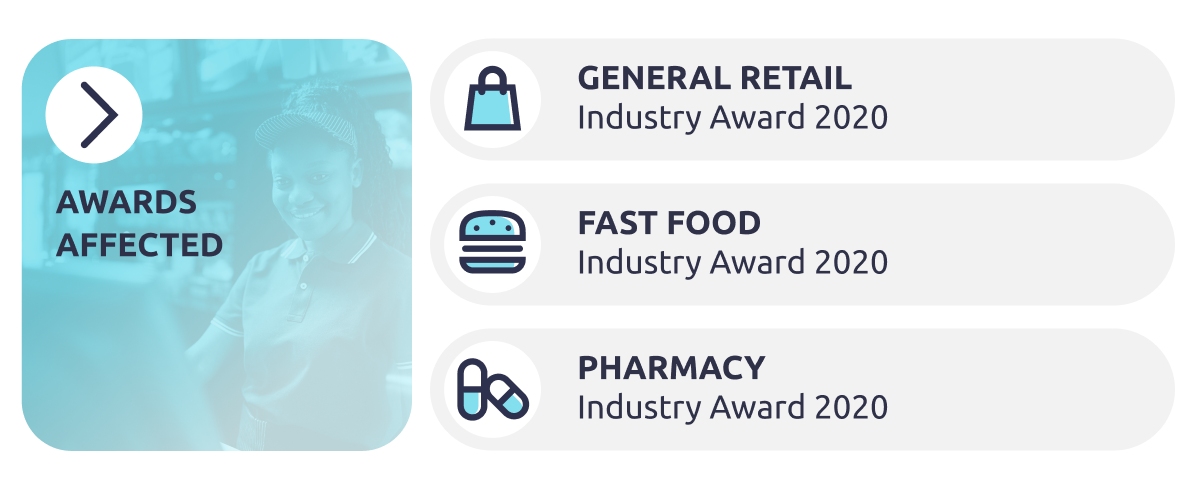
The three awards affected are:
- General Retail Industry Award 2020
- Fast Food Industry Award 2020
- Pharmacy Industry Award 2020
This decision marks a significant shift in modern award standards, and employers in other industries should be on alert as similar applications are likely to be made in the future.
What this means for employees
.png)
For workers aged 18 to 20 in the affected industries, this is a meaningful pay increase. Some workers could earn up to almost $10 more per hour depending on their age, whether they’re permanent or casual, and when the changes take effect.
The change also establishes a significant principle: the new framework recognises 18 as the point of adulthood for wage purposes, aligning pay with broader legal and social expectations.
What this means for employers
The business impact is real, particularly for operators who rely heavily on younger workers to fill rosters. Retail, fast food and pharmacy already rely disproportionately on younger workers to fill rosters, particularly for evening and weekend shifts, meaning the cumulative effect of moving every 18-20 year old to full adult rates represents a material increase in the wage bill.
Beyond the direct cost, there are compliance obligations to manage. Employers covered by the affected modern awards must begin preparing for these changes well ahead of their implementation. Payroll systems will need to be updated to accommodate the staged changes to junior wage rates as they take effect.
Specifically, businesses will need to:
- Track the length of service for all employees ages 18 to 20, as the six-month experience threshold determines when the adult rate kicks in.
- Update pay rates annually in line with the transition schedule through to July 2029.
- Review employment contracts to ensure pay rates reflect the correct award conditions.
- Adjust workforce cost planning and labour budgets to account for the staged increases.
For businesses managing a large number of young casual or part-time staff, manually tracking all of this across a pay cycle is a significant admin burden, and one where errors can quickly create underpayment risk.
How Microkeeper helps you stay compliant
This is exactly the kind of award change where having the right payroll system makes a material difference.
Microkeeper’s payroll engine is built around Australian Modern Awards and is designed to be configured to your specific award interpretation, including staged rate changes like these. Using Microkeeper’s custom rules tool, you can set pay rates rules based on employee age and length of service, so the correct rate is applied automatically at each stage of the transition without any manual calculation or rate-checking at pay run time.
For businesses employing staff under the General Retail Industry Award, Fast Food Industry Award or Pharmacy Industry Award, this means:
- Employees who cross the six-month service threshold are automatically moved to the appropriate adult rate.
- Staged rate increases through the 2026-2029 transition are applied at the correct intervals.
- Payroll calculations are consistent, auditable and aligned with Fair Work requirements at every pay cycle.
This removes genuine compliance risk from your payroll process. Rather than relying on managers to manually identify which employees have reached the experience threshold, and then manually updating their pay rates, Microkeeper handles it in the background, correctly, every time.
Key dates to know
While this ruling currently applies only to the three named awards, the Fair Work Commission’s reasoning, that 18 represents the point of adulthood for wage purposes, sets a strong precedent. Employers in hospitality, healthcare and other award-covered industries should monitor developments closely, as similar applications are widely expected.

.png)